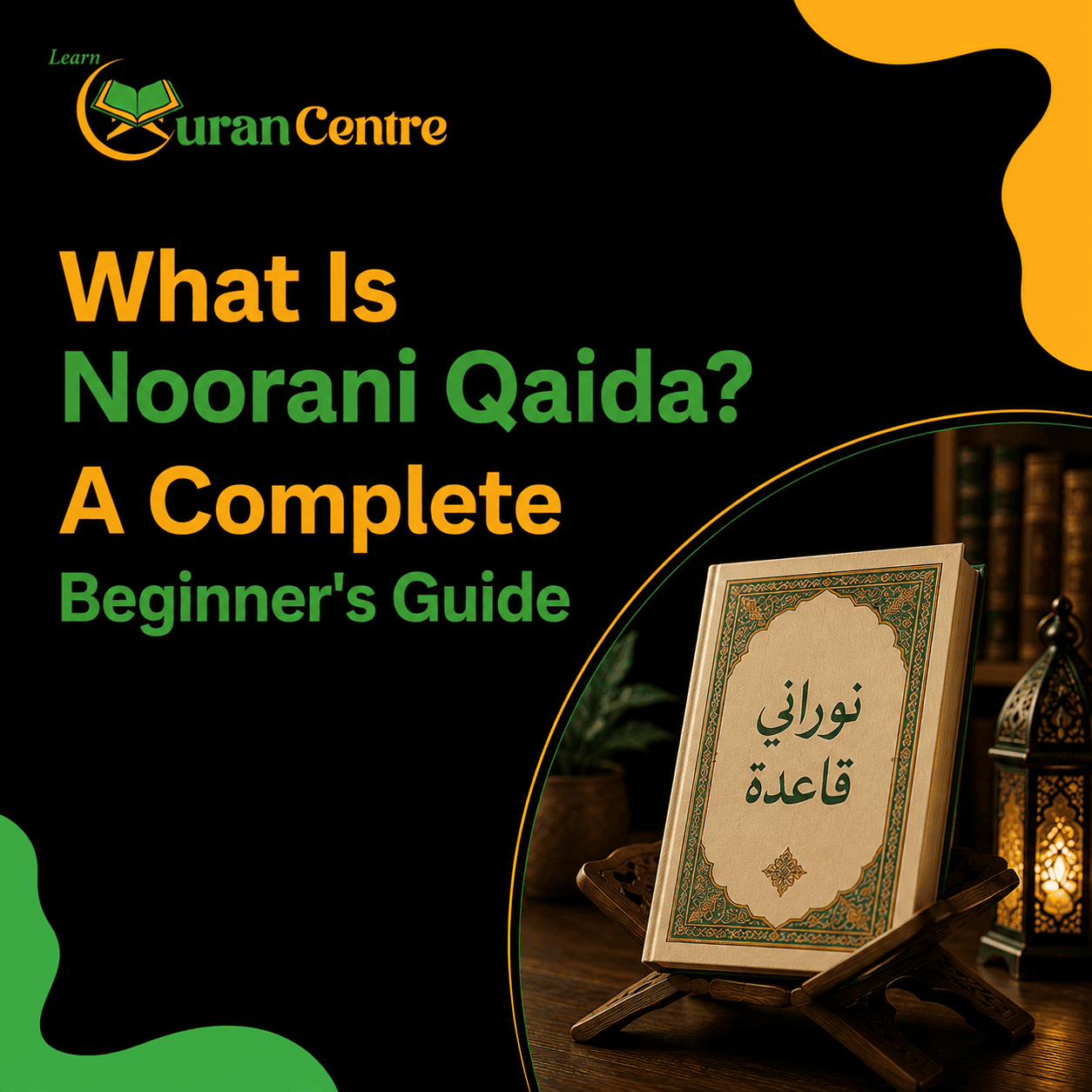
If you want to learn how to read the Quran, one of the first things you may hear about is Noorani Qaida. It is a small and simple book that helps beginners learn the basics of Quran reading.
Many children start with Noorani Qaida before reading the Quran. Adults who never learned Quran reading can also use it. Today, many students also learn Noorani Qaida through online Quran classes from the comfort of their homes. You do not need to know Arabic before starting.
In this guide, we will explain what Noorani Qaida is, what you learn from it, why it is important, and how you can use it to improve your Quran reading.
What Is Noorani Qaida?
Noorani Qaida is a basic book used to teach people how to read the Quran correctly. It starts with simple Arabic letters and slowly teaches the rules needed to read Quranic words.
The lessons usually begin with individual Arabic letters. Then, you learn how letters join together, how to pronounce them, and how different marks change their sounds.
As you move through the lessons, you start reading small combinations of letters and words. This prepares you for reading the Quran.
Think of Noorani Qaida as the first step toward learning to read the Quran.
Why Is Noorani Qaida Important?
Reading the Quran is different from reading English or Urdu. Arabic has letters and sounds that may be new to beginners.
For example, some Arabic letters come from parts of the mouth and throat that we do not normally use when speaking English.
Noorani Qaida gives you a chance to learn these sounds slowly before you start reading full Quranic verses.
It can help you:
- Recognize Arabic letters
- Learn the correct pronunciation
- Understand Arabic vowel marks
- Join letters together
- Read words more easily
- Avoid common reading mistakes
- Build confidence before reading the Quran
- Prepare for basic Tajweed rules
A strong foundation can make Quran reading much easier later.
Who Should Learn Noorani Qaida?
Noorani Qaida is useful for children, teenagers, and adults.
You can start learning it even if you have never read Arabic before.
It is especially helpful for:
- Children starting Quran classes
- Adults learning Quran reading for the first time
- New Muslims who want to learn Quran reading
- People who can read Arabic but struggle with Quranic pronunciation
- Students who want to improve their basic Tajweed
- Parents who want to teach their children Quran reading
You do not need to be a certain age to learn Noorani Qaida.
What Do You Learn in Noorani Qaida?
Noorani Qaida follows a step-by-step learning process. The exact lessons can vary depending on the version or teacher, but the main goal is to build your Quran reading skills from the ground up.
1. Arabic Letters
The first step is learning the Arabic alphabet.
You learn to recognize letters such as:
ا، ب، ت، ث، ج، ح، خ
You also learn how each letter is pronounced.
This is important because changing the sound of an Arabic letter can sometimes change the meaning of a word.
2. Letter Recognition
After learning the letters, you practice recognizing them in different forms.
Some Arabic letters can look different when they appear at the beginning, middle, or end of a word.
Regular practice helps you recognize letters without having to stop and think about each one.
3. Harakat
Next, you learn basic Arabic vowel marks, known as Harakat.
These marks help you know how a letter should sound.
The common short vowel marks include:
- Fatha (َ)
- Kasra (ِ)
- Damma (ُ)
For example, adding a different Harakah to a letter can change its sound.
Learning Harakat is an important part of reading Quranic Arabic correctly.
4. Joining Letters
Once you know individual letters and their sounds, you start learning how letters come together.
This helps you move from reading single letters to reading combinations of letters and then complete words.
This step is important because the Quran is made up of connected Arabic words, not separate letters.
5. Tanween
Noorani Qaida also teaches Tanween.
Tanween is a double vowel mark that adds an n sound at the end of certain words.
The three common forms are:
- Fathatain (ً)
- Kasratain (ٍ)
- Dammatain (ٌ)
Understanding these marks helps you pronounce Quranic words correctly.
6. Sukoon
You will also learn about Sukoon (ْ).
Sukoon shows that a letter does not have a short vowel sound.
Learning Sukoon helps students read words with more accurate pronunciation.
7. Shaddah
Another important lesson is Shaddah (ّ).
Shaddah tells you that a letter should be pronounced with extra emphasis, or as a doubled letter.
It is important to learn how to pronounce Shaddah correctly because it appears often in the Quran.
8. Madd
Noorani Qaida also introduces Madd, which means stretching certain sounds.
Students learn when a sound should be held longer while reading.
Learning Madd helps you develop better Quran reading and prepares you for more detailed Tajweed lessons.
What Is the Difference Between Noorani Qaida and Tajweed?
These two terms are related, but they are not exactly the same.
Noorani Qaida is a learning book and method used to build basic Quran reading skills.
Tajweed is the set of rules used to pronounce Quranic letters and words correctly.
A beginner may start with Noorani Qaida to learn letters, sounds, Harakat, and basic reading patterns. Later, they can study Tajweed in more detail.
In simple words:
Noorani Qaida teaches you how to start reading. Tajweed teaches you how to read more correctly according to the rules.
How Long Does It Take to Learn Noorani Qaida?
There is no fixed time because every student learns at a different speed.
A child who practices regularly may progress quickly. An adult who has never studied Arabic may need more time.
Your learning speed can depend on:
- Your age
- Your previous Arabic knowledge
- How often you practice
- Your pronunciation
- Your teacher’s teaching method
- How much time you spend practicing at home
For many beginners, regular practice is more important than learning quickly.
Even 15–20 minutes of daily practice can be useful if you stay consistent.
Can Adults Learn Noorani Qaida?
Yes. Adults can learn Noorani Qaida at any age.
Some adults may feel nervous because they think they are too old to start. There is no reason to feel this way.
If you can learn a new language, skill, or habit, you can also learn the basics of Quran reading.
An experienced Quran teacher can start from the beginning and help you improve step by step.
Can Children Learn Noorani Qaida Online?
Yes. Many children now learn Noorani Qaida through online Quran classes.
Online classes can be useful for families who want their children to learn from home.
A typical online lesson may include:
- Reading the lesson with the teacher
- Listening to the correct pronunciation
- Repeating letters and words
- Correcting mistakes
- Practicing the lesson after class
Parents can also help by giving children a quiet place and a regular time for Quran learning.
How to Learn Noorani Qaida at Home
You can practice Noorani Qaida at home, but having a qualified teacher can make the process easier.
If you are studying on your own, try these simple steps:
Start With the Basics
Do not skip the early lessons. Make sure you can recognize and pronounce the Arabic letters before moving forward.
Practice Out Loud
Quran reading is not only about recognizing letters. You need to practice the sounds.
Read each lesson aloud and listen carefully to your pronunciation.
Practice Every Day
Try to practice a little every day instead of studying for a long time only once a week.
Regular practice helps you remember what you learn.
Listen to a Good Teacher
Listening to a qualified Quran teacher can help you notice sounds that are difficult to pronounce.
Do Not Rush
Moving to the next lesson before understanding the current one can create problems later.
Take your time and make sure you understand each lesson.
Common Mistakes Beginners Make
Beginners often make small mistakes while learning Noorani Qaida. This is normal.
Some common mistakes include:
- Mixing up similar Arabic letters
- Pronouncing Arabic sounds like English sounds
- Ignoring vowel marks
- Reading too quickly
- Skipping difficult lessons
- Not practicing regularly
- Moving ahead without correcting mistakes
The good news is that most of these problems can improve with practice and guidance.
Why Learn Noorani Qaida With a Teacher?
You can find Noorani Qaida lessons online and practice by yourself, but a teacher can provide something that a book cannot: instant correction.
A teacher can listen to your reading and tell you when:
- A letter is pronounced incorrectly
- A sound is too short or too long
- A Harakah is missed
- A letter needs more emphasis
- You are making the same mistake repeatedly
This can save time and help you build good reading habits from the start.
Noorani Qaida for Quran Reading
Noorani Qaida is not the Quran itself. It is a learning tool that prepares beginners to read the Quran.
Students first learn the building blocks of Quran reading. Once they become comfortable with letters, sounds, and basic rules, they can begin reading Quranic words and verses.
This step-by-step approach can make the transition to Quran reading much easier.
Final Thoughts
Noorani Qaida is one of the simplest ways for beginners to build their Quran reading skills. It starts with Arabic letters and gradually introduces sounds, vowel marks, joined letters, and basic reading rules.
Whether you are a child or an adult, you can start learning Noorani Qaida from the beginning.
The most important things are patience, regular practice, and correct pronunciation. If you practice consistently and learn from a qualified teacher, you can build a strong foundation for reading the Quran.
If your goal is to read the Quran confidently and correctly, Noorani Qaida is a great place to start.